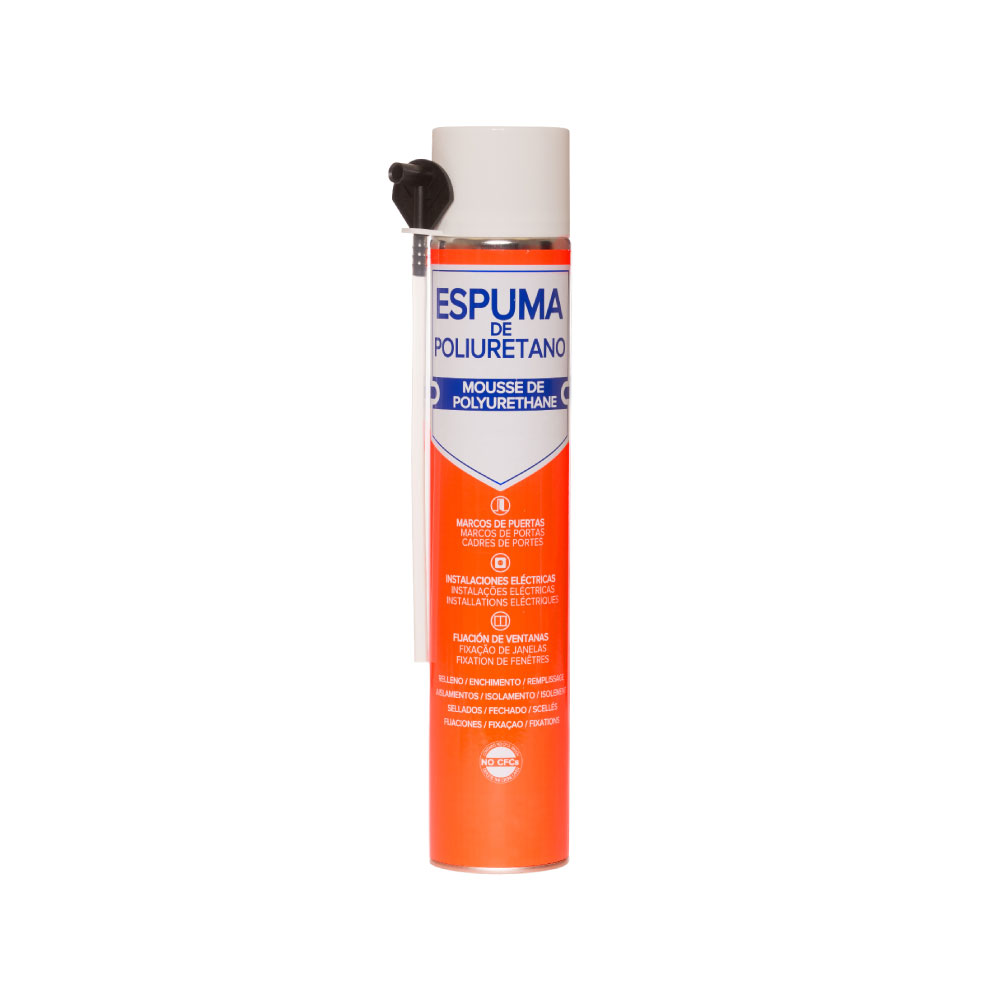
Description

Polyurethane foam is a single-component, expanding product for thermal and acoustic insulation. Adhesion to any type of construction material. Once hardened, it can be cut, sanded, painted, etc. It is resistant to ageing and large temperature differences.
Color: Yellowish
Expanded specific weight: 20-25 Kg./m3
Expanded volume 35 lt.
Tensile strength: at + 20ºC 11 N/cm2 at – 20ºC 18 N/cm2
Elongation and Breakage (DIN 53455) 25%
Flexibility: 15 N/cm2
Compressive strength: 60 KPa
Water absorption (DIN 53428): 0.3 % vol.
Resistance to atmospheric agents Yeah
Thermal conductivity (DIN 52612): 0.07 W/mºK
Temperature resistance (continuous): – 40ºC + 90ºC
Product application temperature: +5 to + 35ºC
Substratum: +10 to +35ºC
Optimal application temperature: 20ºC
Tack free : 10 min.
Time to be able to cut it: 1 hour
Cellular structure 70 % closed
Elastic limit (DIN 53455) 175 Kpa
Dimensional stability (after 24 hours) 0-2%
Adherence: Wood, concrete, stone
Metals: excellent
Silicone: It doesn't stick
Tests performed on a 20mm foam bead at 20ºC and relative humidity of the 60%.
- Shake well before use. The ideal temperature for application is 20ºC (+/- 5ºC). If it is necessary to bring the container to this temperature, immerse it in warm water.
- Upon exit, the foam expands during the hardening phase to around 120 % and will be hardened within 2 hours, depending on the temperature, air humidity and applied thickness.
- Once hardened, it can be mechanically worked (cut, drilled, painted).
The foam adheres to almost all surfaces, such as walls, reinforced concrete, asbestos, wood, plastic, etc.) - It does not attack oily, greasy or dusty surfaces such as polyethylene, Teflon and silicone.
- For construction elements that cannot support themselves, they must first be secured with a nail, wedge or similar, and the fixing cannot be removed until 12 hours have passed.