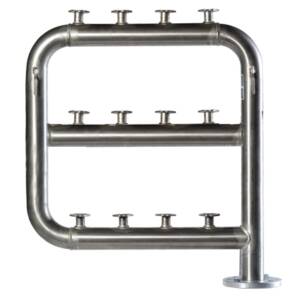
Description

Polypropylene batteries.
Cohisa Polypropylene batteries use Copolymer Polypropylene – Random PP-RCT. In diameters of 63, 75 or 90 mm in accordance with the UNE 53943 standard entitled: “Batteries and collectors made of plastic materials for the centralisation of water meters. Batteries and collectors made of polyethylene (PE) and polypropylene (PP) with heat-sealed joints”.
Likewise, the pipes and accessories used for manufacturing comply with the UNE ISO 15874 standard, and the standards relating to the connection components are complied with, such as the UNE 19804 standard relating to valves for the installation of cold water meters in batteries, the UNE –EN 1092-1:2019 standard on circular flanges for pipes, taps, accessories, etc., and any other standard that is referenced and applicable in the UNE 53943 standard.
This type of material offers technical characteristics such as:
– Absence of corrosion and electrolytic phenomena.
– Reduction of condensation and thermal dispersion.
– Lower weight than traditional batteries.
– Less friction and load losses.
– Greater resistance to frost
– Lower noise and greater shock absorption.
– Long service life
In addition, the development and material of Cohisa's Polypropylene batteries offer differentiating characteristics such as:
– Fire behaviour B S1, d0. The pipes and fittings used are additive-treated to pass the reaction to fire tests with classification B-S1, d0.
– Halogen-free, a key feature in the event of a fire reaction; it does not produce toxic gases, thus protecting people and the environment.
– Resistance to disinfection processes: The pipes and accessories are additive-free to withstand high concentrations of chlorine and disinfection processes.
– Antimicrobial Protection: the system incorporates an antimicrobial additive that prevents the generation of biofilm and eliminates the development of bacteria.
– Anti-scaling protection: the pipe incorporates an anti-fulling additive in its inner layer that causes a slide effect, reducing roughness and preventing scaling.
– Anti-expansion microfibers: the pipe has glass microfibers in its intermediate layer, which give it greater rigidity and reduce expansion by 75%.
– UV protection: the pipe has antioxidants incorporated into its outer layer that help minimize degradation in the event of sun exposure.